
Threadbare
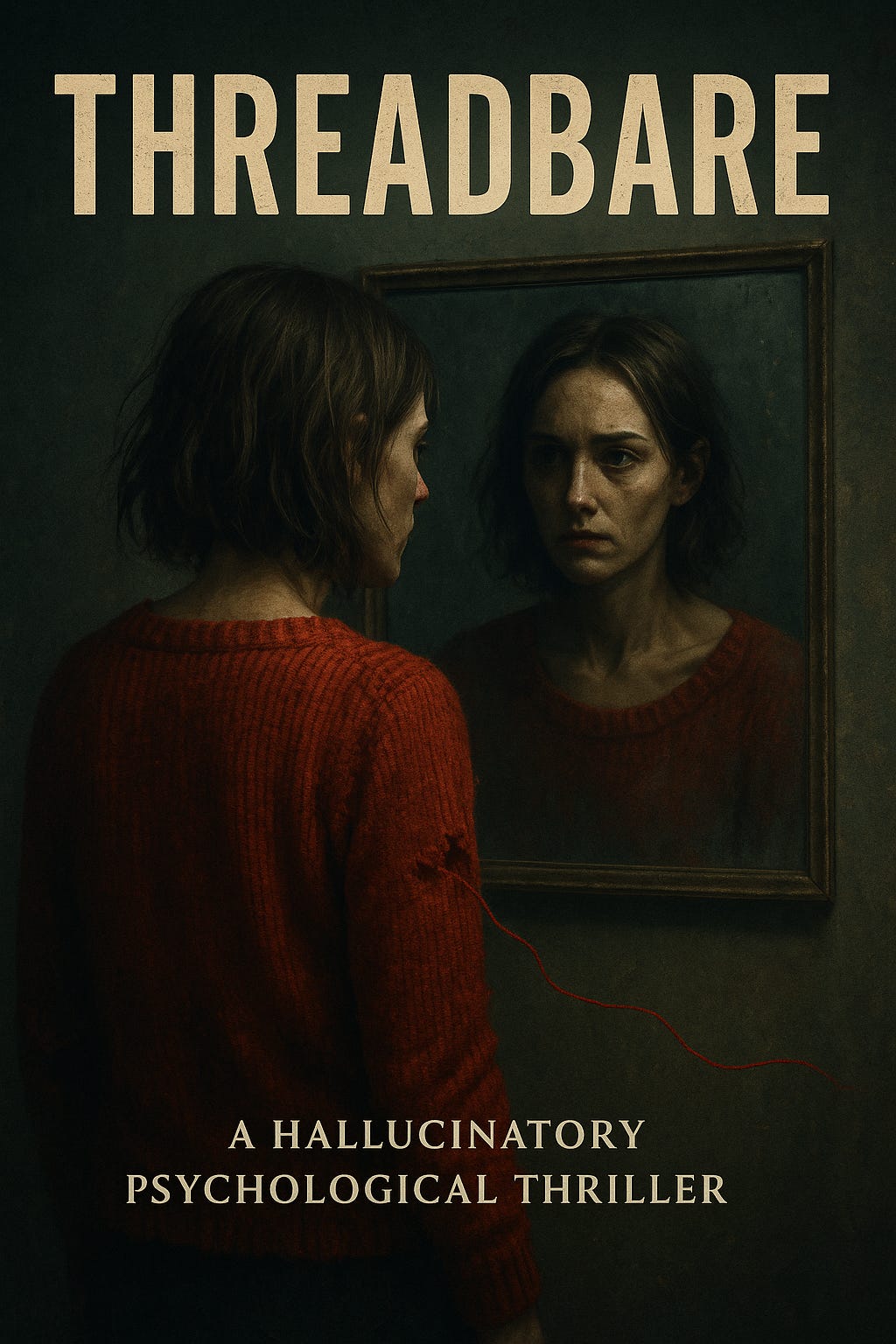
Threadbare is a hallucinatory psychological thriller crossed with transgressive fiction, where grief takes the shape of a rental home and memory becomes a predator.

HOOK (275 words)
Threadbare is a hallucinatory psychological thriller crossed with transgressive fiction, where grief takes the shape of a rental home and memory becomes a predator.
Lucie has spent the last eight months pretending she didn’t see her sister die. Her therapist says it’s dissociation. Her landlord says she should stop rearranging the furniture every night. But Lucie knows better. The house knows better.
When she finds a torn piece of her sister’s favorite red sweater in the air vent, Lucie begins unraveling—and not just emotionally. Rooms appear where none should be. Scratches form on her arms in the shape of things she hasn’t touched. And something that looks like her sister is knocking from inside the walls.
In the end, Lucie will have to decide if she’s the one haunting the house—or if it’s been wearing her face all along.
Fans of Ottessa Moshfegh and early Cronenberg will find themselves at home in this taut, claustrophobic, grief-soaked descent into the self.
SYNOPSIS (150 words)
After the sudden death of her younger sister, Lucie retreats into a sparse rental house on the outskirts of town. She doesn’t speak to her mother. She doesn’t go to work. She only exists, day by day, in a routine of pills, tea, and avoidance.
But the house won’t let her forget.
Lucie starts finding pieces of her sister—a childhood hair ribbon in the freezer, her chipped nail polish smeared on the wall, teeth in the drain. As the boundaries of reality and memory erode, Lucie suspects the house is rebuilding her sister out of grief, piece by piece. Worse, she doesn’t know if she wants it to stop.
With each night, the seams between Lucie and her dead sister fray further, until one of them has to let go.
Or be let go of.
STORY: “Threadbare” (exactly 1000 words)
The red thread is back.
Lucie finds it curled beneath the kitchen table like a vein pulled loose from the house itself. She plucks it with a shaking hand. It stretches but doesn’t snap.
She doesn’t remember the sweater being here. The red one. The one Eloise wore the night she died.
Lucie wraps the thread around her wrist like a tourniquet.
The first night, she hears humming from inside the walls.
A song she almost remembers. Something Eloise made up when they were small. The kind of tune you hum when you want to feel like you’re not alone. Or when you want someone else to think you aren’t.
She presses her ear to the plaster and whispers, “Stop it.”
The wall breathes.
By the third night, she’s moved the bed. The desk. The kitchen chairs.
The windows no longer line up with the rooms. The hall curves in a direction that leads nowhere and everywhere. She leaves post-it notes on the doors just to remember which ones open.
One reads: DO NOT ENTER (yesterday’s bathroom)
One reads: her door (maybe)
One is blank, but scrawled with red thread. She doesn’t remember writing that one.
She finds the tooth in the drain.
Molar. Chipped. Slightly yellow. It winks at her.
Lucie sets it on the counter beside the sink and speaks to it as she brushes her teeth.
“You shouldn’t be here either,” she tells it.
It doesn’t leave.
Her therapist says the grief is getting louder. Suggests journaling.
Lucie buys a notebook but can’t bring herself to write in it. Instead, she carries it from room to room like a talisman. Like a shield.
The house sighs whenever she opens it.
Lucie wakes one night with the red thread between her teeth.
She pulls and pulls and it keeps coming. Her jaw aches. Her stomach turns. Still, she pulls.
When she reaches the end, it’s knotted around a button. Small, white, plastic. From Eloise’s sweater.
She swallows it.
She dreams of being folded inside a closet. Not locked in, but tucked. Safe. And behind her, arms wrap around her middle. A voice in her ear:
“You’re doing so well. Just a little longer.”
Lucie wakes with bruises on her ribs and the taste of lavender in her mouth.
The house doesn’t creak anymore. It clicks.
Like something building. Like a jaw resetting.
Like teeth.
The red thread is everywhere now. Tangled in her hair. Sewn into the sheets. Dangling from the vents. A web of memories she can neither ignore nor understand.
One morning, she finds her own handwriting on the wall:
“She was here. I let her in.”
Below that, in a different hand, more delicate:
“Thank you.”
Lucie stops sleeping in the bedroom.
She opens the door that used to lead to the laundry room and finds a nursery.
She has never been pregnant. Never bought baby clothes. But the room smells like talc and sorrow.
There is a crib. Inside it, a red sweater stitched from thread so fine it breathes.
The sleeves are too long.
She wraps herself in the sweater. She doesn’t remember doing it, but she wears it now, and her skin itches with every breath.
The house sings to her.
“Let me go. Let me go. Let me—”
No, not sings. Not quite. Pleads.
Lucie tightens the sweater around her shoulders.
“No. Not yet.”
There is a girl in the mirror.
She looks like Eloise. If Eloise had grown up. If Eloise had survived.
She touches the glass. Her smile is tired and wide.
“You’re not Lucie,” she says.
Lucie stares. Her teeth ache. Her reflection flickers.
She hums the song from the walls.
The girl hums it back.
The house is quiet now. No more knocking. No more red.
Only a note by the door:
“You let her in. Now let her go.”
Lucie folds it into her palm.
She opens the door to the laundry room.
There is no room.
Only the wall.
Only the mirror.
Only her.
By Amber Jensen (and voices in the shadows)
If this story found its way into your bones, you can help the hum travel farther.
💀 Restack, share, and subscribe to stay close to the dark fiction and mythic side of the work—
so you don’t miss what’s still to come.
🕯️ Tips and offerings of gratitude are always welcome here →.